Most people compare appliances the same way: they line up the prices and pick the lowest one they can live with. It feels sensible, but it is the single most common buying mistake. Price tells you what an appliance costs today. It tells you nothing about what it will cost you over the next five or ten years. But value is a different thing entirely, and once you know how to look for it, you buy better every time. This guide gives you a practical framework for comparing appliances properly with a checklist to take with you.
What You Will Find in This Guide
- Why price is the worst place to start
- How to work out the true cost of ownership
- What a warranty reveals about a manufacturer
- How to read specifications without getting lost
- Why after-sales support matters
- A pre-purchase checklist for any appliance
Why Price Is the Worst Place to Start
A low price is only good news if everything behind it holds up.
Appliances are made cheaper by using thinner materials, simpler motors, fewer safety features and shorter warranties. None of that is visible on the shelf, but all of it shows up later, usually as a repair bill or an early replacement.
Starting with price means you are comparing the one number that says least about how the appliance will actually perform in your home.
Total Cost of Ownership: The Number That Matters
The figure worth calculating is what an appliance costs you across its whole life.
That means three things added together: what you pay upfront, what it costs to run, and how soon you will have to replace it.
Running costs are where the gap usually opens. An efficient appliance quietly saves money every time you use it, and over several years that adds up to far more than a small difference in purchase price.
A tumble dryer like the Bennett Read 8kg Aero Dry detects moisture levels and adjusts the cycle automatically, so it stops when the load is dry rather than running on and wasting electricity.
A cheaper dryer without that feature costs less on day one and more every week after that.
Replacement timeline matters just as much. An appliance that lasts eight years at a fair price is better value than one that lasts three at a low one.
What a Warranty Really Tells You
A warranty is not just paperwork . It is a manufacturer telling you, in writing, how long they expect their product to last.
A brand offering one year is making a very different statement to one offering three. It costs money to honour a long warranty, so nobody offers one on a product they expect to fail.
This is worth checking closely because the difference is easy to spot.
The Bennett Read 17kg Top Loader Washing Machine and the Crystal 90cm Gas Electric Stove both carry a 3 year warranty, and several appliances in the range can be extended simply by registering online.
When comparing two similar appliances, the warranty is often the clearest signal of which one is built better.
How to Read Specifications Without Getting Lost
Specification lists are long and mostly unhelpful unless you know which numbers apply to you.
Three things are worth focusing on.
Wattage
Wattage tells you how much power an appliance draws, but higher is not automatically better.
What matters is wattage matched to the job, because an efficient appliance that heats quickly may use less electricity overall than a lower-wattage one that runs for longer.
Capacity
Capacity should match your household, not your ambitions.
A 17kg top loader earns its space in a large family home with bedding and towels to get through, while a smaller washing machine is the better buy for two people.
Paying for capacity you never use is money wasted.
Features
Features are only valuable if you will use them.
A wok burner, an anti-crease cycle or a dehydrate setting each add real value to the right household and nothing at all to the wrong one.
After-Sales Support: The Part Nobody Checks
Every appliance will eventually need something, whether that is a part, a repair or simply an answer.
This is where customer support quietly decides whether your purchase was a good one.
Before buying, find out whether the brand has a support department you can actually reach, whether there are service centres in the country, and how spare parts are handled.
Bennett Read products are backed by a dedicated Customer Care department and national service centres, which is exactly the kind of thing that costs nothing until the day you need it.
Your Pre-Purchase Checklist
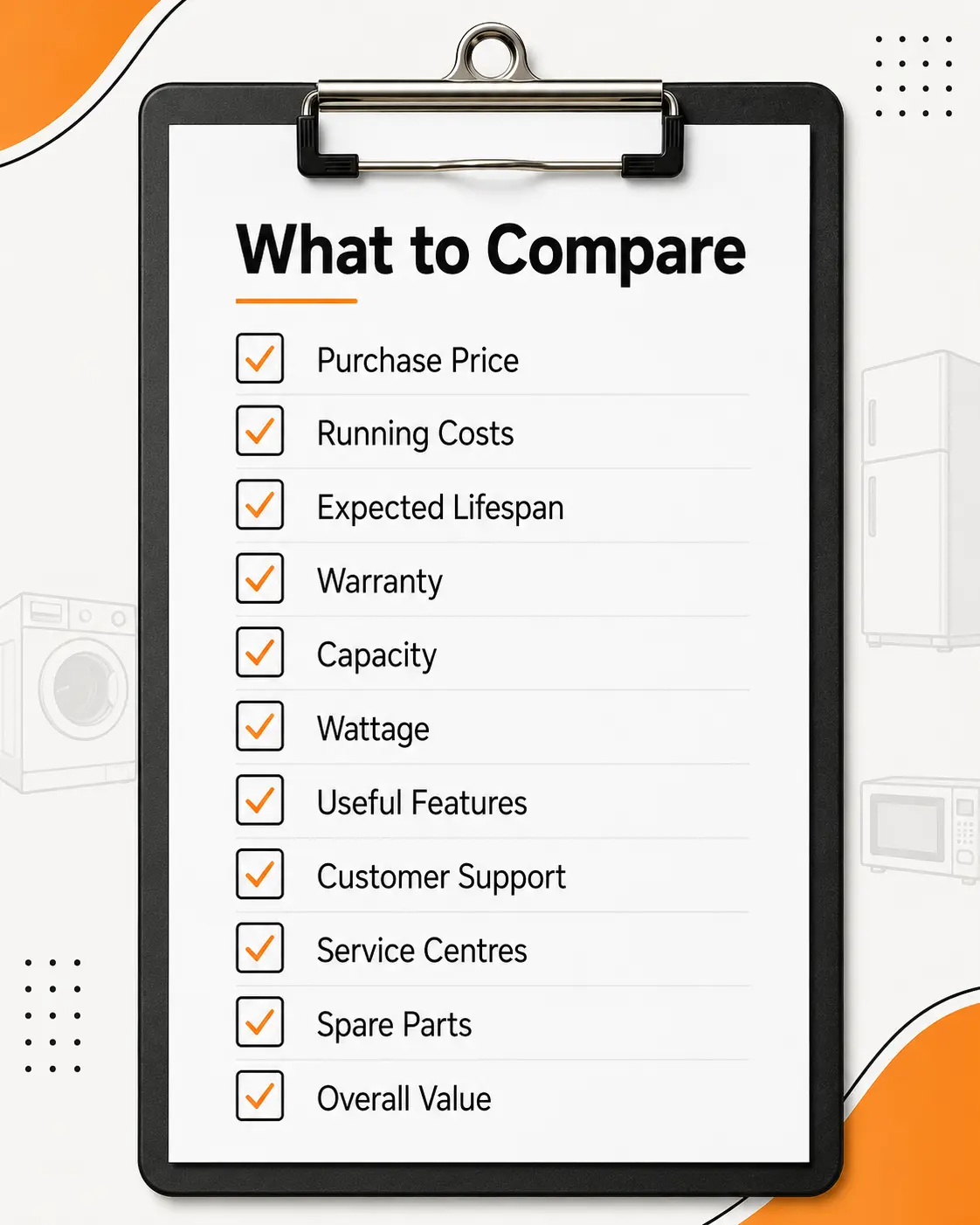
Take these questions with you. If an appliance answers all seven well, it is worth your money:
- What will this cost me to run each month, not just to buy?
- How long is the warranty, and can I extend it?
- Does the capacity match my household as it is now?
- Which features will I genuinely use?
- Is there local customer support and are service centres available?
- Are spare parts and servicing easy to arrange?
- How long should this realistically last before replacement?
Comparing appliances properly takes a few extra minutes and saves you a great deal more than that over the years you own them.
Look past the price, add up the real cost of ownership, treat the warranty as the signal it is, read only the specifications that apply to your home, and check that support exists before you need it.
Do that consistently and you will stop replacing appliances and start keeping them.
FAQs
What does a warranty mean?
A warranty is a manufacturer's written promise to repair or replace a product if it fails within a set period, provided it has been used correctly.
It is also a signal of confidence: a longer warranty suggests the manufacturer expects the appliance to last.
Many Bennett Read appliances come with a warranty that can be extended by registering online after purchase.
What is customer support?
Customer support is the help a brand provides after you have bought a product.
It covers advice, troubleshooting, repairs, spare parts and servicing.
Good support means a department you can actually reach and service centres within the country.
It costs you nothing until something goes wrong, at which point it matters enormously.
How do I make a buying checklist?
List the things that will affect you over the life of the appliance rather than at the till.
Running costs, warranty length, capacity for your household, features you will genuinely use, availability of customer support and spare parts, and expected lifespan.
Take the list with you and answer each question for every appliance you are considering.
How do I compare appliances?
Compare total cost of ownership rather than price.
Add the purchase price to estimated running costs, then weigh that against how long the appliance should last.
Check the warranty, match the capacity and wattage to your household, ignore features you will not use, and confirm that local support and servicing are available before you buy.