Every appliance in your home has a wattage rating, but very few of us know what that number actually means, or how it affects the bill at the end of the month. With South African electricity prices climbing year after year, understanding wattage is one of the simplest ways to take control of what you spend. This guide explains what wattage really means, how it links to energy consumption, and how to work out what your appliances are costing you.
What You Will Find in This Guide
- What wattage actually measures
- Why wattage alone does not tell the full story
- How to calculate what an appliance costs to run
- Which appliances use the most electricity
- Practical ways to reduce your consumption
What Is Wattage?
Wattage measures how much power an appliance draws while it is running, shown in watts (W) or kilowatts (kW). One kilowatt is 1,000 watts, and a higher wattage means the appliance pulls more power at any given moment. A 2000W appliance like the Bennett Read 2000W Steam Iron draws far more power than a toaster or an electric blanket. But wattage on its own only tells you half the story.
Why Wattage Alone Does Not Tell the Full Story
What really drives your electricity consumption is wattage combined with time. A high-wattage appliance used for a few minutes can cost less to run than a low-wattage one left on for hours. Your iron might draw 2000W, but you only use it in short bursts. An electric blanket like the Bennett Read Electric Blanket Queen draws very little power, even across a full night. Energy consumption is always about power and time together, not wattage alone.
How to Calculate What an Appliance Costs
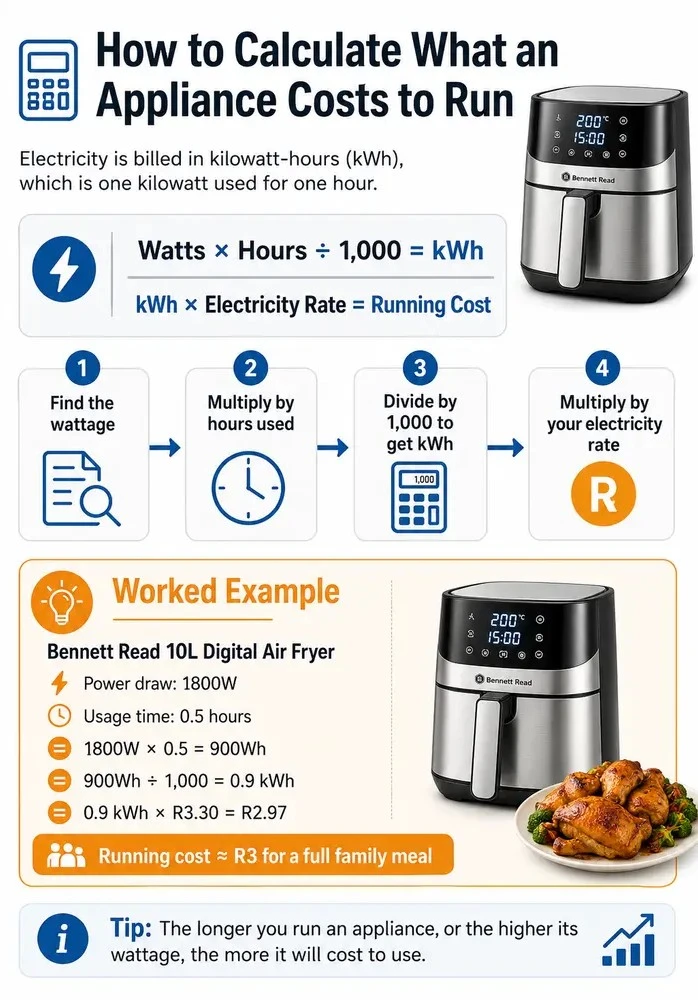
Electricity is billed in kilowatt-hours (kWh), which is one kilowatt used for one hour. The formula is simple:
Watts × Hours ÷ 1,000 = kWh
Multiply the result by your electricity rate to calculate the running cost.
For example, the Bennett Read 10L Digital Air Fryer draws up to 1800W.
- 1800W × 0.5 hours = 900Wh
- 900Wh ÷ 1,000 = 0.9 kWh
- At around R3.30 per unit, that works out to roughly R3 for a full family meal.
Which Appliances Use the Most Electricity
The biggest electricity users combine high wattage with long running times, which is why anything that heats or cools tends to dominate your bill. Common high-energy appliances include:
- Geysers
- Heaters
- Tumble dryers
- Ovens
This is where efficient design pays off. An air fryer cooks faster than an oven and uses less energy per meal, while a washing machine like the Bennett Read 14kg Twin Tub uses water efficiently and spin dries clothes to reduce overall drying time.
Smarter Use of Everyday Appliances
Small habits can make a noticeable difference over time.
- Run your washing machine with full loads.
- Iron several items in one session while the plate is hot.
- Use energy-saving settings wherever they are available.
- Choose appliances that suit the task instead of always using the largest appliance available.
Choosing efficient appliances and using them wisely is one of the easiest ways to keep both your electricity consumption and your bill under control.
Wattage is not something to fear, it is something to understand. Once you know what the number means and how it translates into real running costs, you can make smarter choices about which appliances you buy and how you use them. In a country where electricity keeps getting more expensive, that knowledge is genuinely worth having.
FAQs
What consumes the most electricity in your home?
Appliances that heat or cool tend to use the most electricity because they combine high wattage with long running times. The biggest users are typically:
- Geysers
- Heaters
- Tumble dryers
- Ovens
- Dishwashers
Quick-use appliances like a toaster or an iron draw high power but only run briefly, so they usually cost much less over the course of a month.
How do you calculate electricity consumption?
Use this formula:
Watts × Hours of Use ÷ 1,000 = Kilowatt-hours (kWh)
For example, an 1800W air fryer running for one hour uses 1.8 kWh.
Multiply the kWh figure by your electricity rate per unit to calculate the running cost.
How many kWh is R500 of electricity?
It depends on your municipal tariff.
At an average South African rate of around R3.20 to R3.50 per kWh in 2026, R500 buys roughly 140–155 kWh (units).
Rates vary between municipalities, so check your electricity bill or prepaid slip for your exact tariff.
How much is 1 kW per hour?
Running a 1kW appliance for one hour uses exactly 1 kWh, which is one unit of electricity.
At around R3.20–R3.50 per unit, that costs roughly R3.20–R3.50.
A 2000W (2kW) appliance running for the same amount of time uses 2 kWh, so it costs about twice as much.
What is the meaning of energy consumption?
Energy consumption is the total amount of electricity an appliance uses over time, measured in kilowatt-hours (kWh).
It depends on two factors:
- How much power the appliance draws (its wattage)
- How long it runs
This is why a low-wattage appliance used for many hours can consume more electricity than a high-wattage appliance used only briefly.